
A photograph, in most hands, is an act of noticing. In Jane Gottlieb’s hands, it is closer to an act of invention. For more than thirty years, she has turned her camera toward the kind of scenes most people walk past without a second glance, and returned with something that looks less like a record of the world than a translation of it, filtered through color, light, and an imagination that refuses to leave things as it found them.
Light Becomes Atmosphere

Gottlieb’s photographs do not simply depict light; they are built from it. Across her body of work, illumination functions less as a technical necessity and more as an emotional register, shifting an ordinary scene into something closer to a mood or a memory. This is not a trick of unusual subject matter. It is a matter of attention, the kind that comes from decades spent looking closely at the world and asking what it might become rather than only what it already is.
That attention did not arrive fully formed. It was built slowly, across a career that began with formal study at UCLA and Berkeley and continued through years spent working on Madison Avenue and across various companies before Gottlieb arrived at the realization that her most authentic work would come from trusting her own instincts rather than deferring to a mentor’s guidance. Confidence, in her telling, was never a gift. It was assembled, gradually, through disappointment and persistence in equal measure.
Color Becomes Emotion
If light gives Gottlieb’s photographs their atmosphere, color gives them their pulse. She treats color not as a passive property of her subjects but as an expressive force in its own right, something to be intensified, layered, and reorganized until an ordinary object takes on the charge of something felt rather than simply seen. Fruit, storefronts, skies, and structures all pass through this same transformation, emerging on the other side charged with a vividness that has less to do with their original appearance than with Gottlieb’s own visual imagination.
The Ordinary, Reconsidered

It would be a mistake to read Gottlieb’s fascination with the everyday as a limitation, a matter of working with what happens to be nearby. It is, instead, the central premise of her practice: that the extraordinary is already present in ordinary surroundings, waiting for a particular kind of attention to draw it out. This premise has sustained her across more than three decades of work, resistant to the kind of exhaustion that often accompanies a single, narrow subject. Because her real subject has never been any one object or scene. It has been the act of transformation itself.
Architecture Enters the Frame
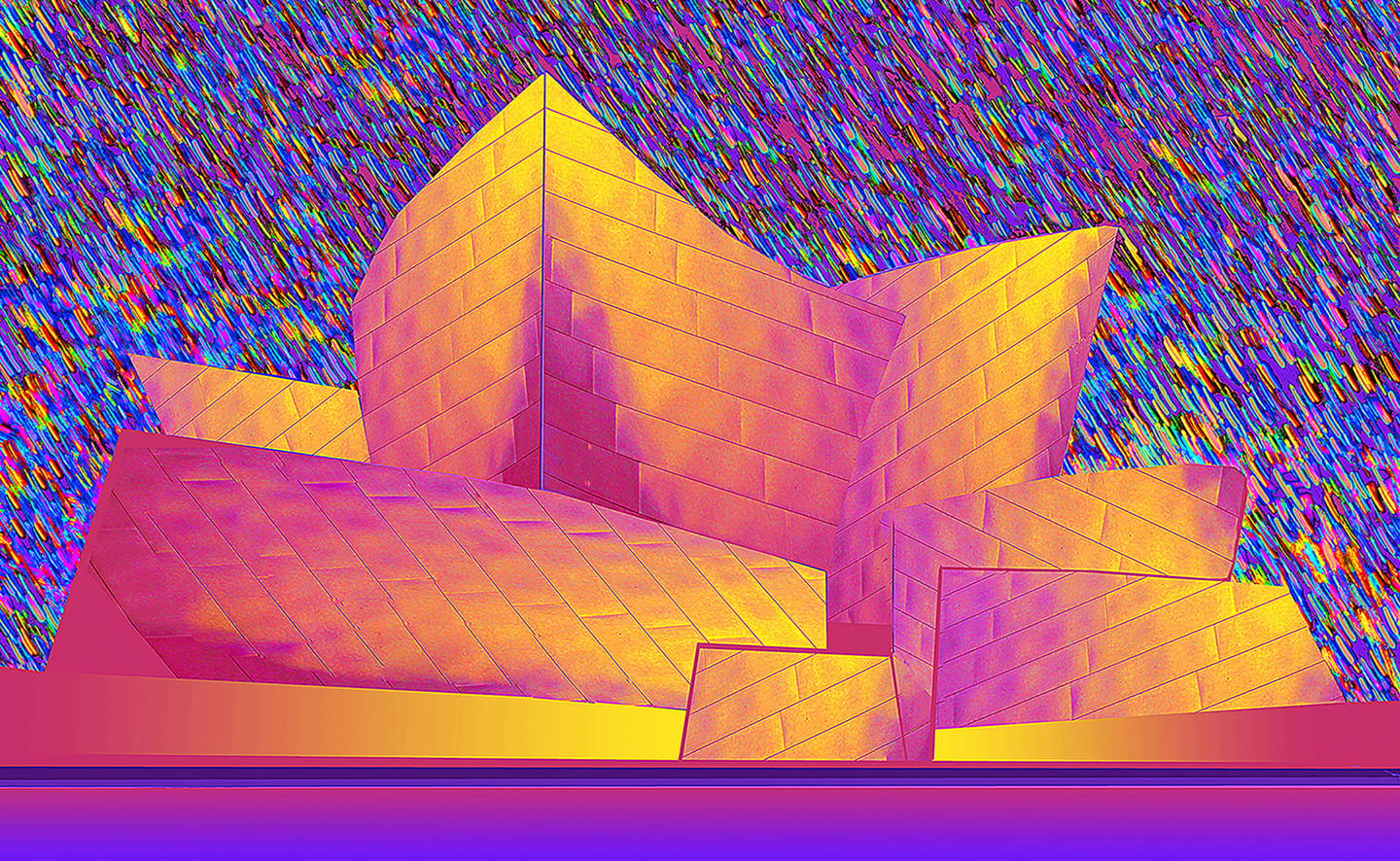
That premise finds one of its most sustained expressions in Gottlieb’s long relationship with the architecture of Frank Gehry. She photographed for Gehry many years ago, early enough that the connection has had decades to deepen, and has remained an admirer of his work ever since, returning to his buildings again and again as a subject worthy of continued exploration. Her photographs of his structures in Bilbao and Los Angeles form a body of work in which architecture stops behaving like architecture and starts behaving like material: something to be reshaped, recolored, and reconsidered rather than simply recorded.
Gehry’s buildings, with their curved steel and their refusal of straight lines, offer an unusually generous invitation to this kind of transformation. Gottlieb has taken up that invitation directly, using Photoshop to paint, combine, and enhance her photographs of his work, extending each structure’s already unconventional logic further still through color and composition. The buildings do not disappear beneath this process. They are, if anything, intensified by it, pushed toward a version of themselves that exists only in Gottlieb’s imagination and, now, in the photographs she has made from it.
A Practice Still Unfolding
There is something quietly radical in an artist who, after thirty years, is still finding new territory within a premise as simple as seeing the extraordinary in the everyday. Gottlieb’s photographs, exhibited by galleries, museums, and universities around the world, testify to just how much territory that premise still contains. Her recent appointment as the first artistic trustee on the board of the University of California, Santa Barbara extends that same instinct outward, into a role focused on bringing more art and creativity to a campus community rather than only to a gallery wall.
What ties these threads together, the early photographs, the Gehry collaborations, the institutional work now underway, is a consistent refusal to treat the ordinary as a ceiling. Gottlieb’s career suggests that the extraordinary was never hiding somewhere exotic, waiting to be discovered. It was here all along, in a building’s steel skin or a stretch of afternoon light, waiting for someone willing to look twice and imagine harder. That, more than any single photograph, may be Gottlieb’s most enduring subject.
Explore available limited-edition prints and museum-scale artworks directly at janegottlieb.com.