
Some paintings tell you what to think. Lib Mason’s paintings tend to ask a question instead, and then let you stand there with it for a while.
A Career That Made Room for Questions
Mason spent much of her working life answering to other people’s needs. Trained in editorial illustration at the Rhode Island School of Design, she built a commercial career creating images for major publications, including Rolling Stone and Time Life Warner, and later expanded into product development and artist-branded licensed lines. It was steady, skilled work, but it wasn’t hers to direct.
About eight years ago, that chapter ended, and Mason returned to painting with a kind of freedom she hadn’t had before: no client, no brief, no predetermined subject. What she chose to do with that freedom says a lot about her as an artist. She didn’t turn toward easier or more comfortable material. She turned toward the things that seem to actually keep her up at night, power, truth, the world we’re leaving behind for children, and she gave herself the time to think through them slowly, using a demanding oil-painting technique built on patient, layered construction.
Painting as a Way of Sitting With Difficulty
Mason’s process begins with a grisaille, a monochrome underpainting that resolves the light and form of a composition before any color is introduced. From there, she builds the image through repeated transparent glazes, letting color and luminosity develop gradually rather than all at once. It’s worth pausing on how unhurried this is. Where illustration rewards speed and immediacy, this technique rewards the opposite, a willingness to let a painting take shape over time, layer by layer, the same way understanding a difficult subject often takes longer than a first glance allows.
That patience shows up in how she handles her subjects, too. Mason draws from political, social, and environmental events, but she isn’t interested in illustrating them directly. She reaches instead for beauty, symbolism, humor, and absurdity, tools that let a viewer approach something unsettling without being overwhelmed by it immediately. The paintings invite you in before they tell you what they’re actually about, and that gap between first impression and full understanding seems to be exactly where Mason wants you to linger.
Power, Seen and Unseen
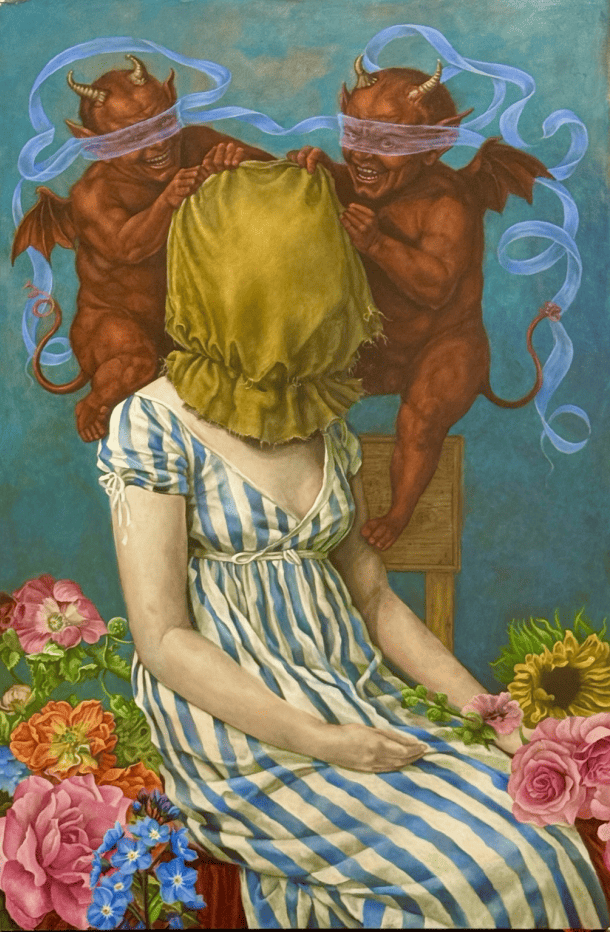
RIP ICE, painted in response to the shooting of Renee Good, sits with a hard question about power: what happens when it operates without truly seeing the person in front of it. Two grinning, blindfolded devils pull a hood over a seated woman, the whole scene rendered in brilliant color and flowers, a beauty that stands in uncomfortable contrast to what’s actually happening beneath it. Mason painted the woman’s skin chalky and uneven on purpose, refusing to let her be defined by race or identity. She could be anyone, which is exactly the point: when power goes unchecked and inadequately trained, Mason seems to be suggesting, no one is necessarily beyond its reach.
What Innocence Might Build Instead
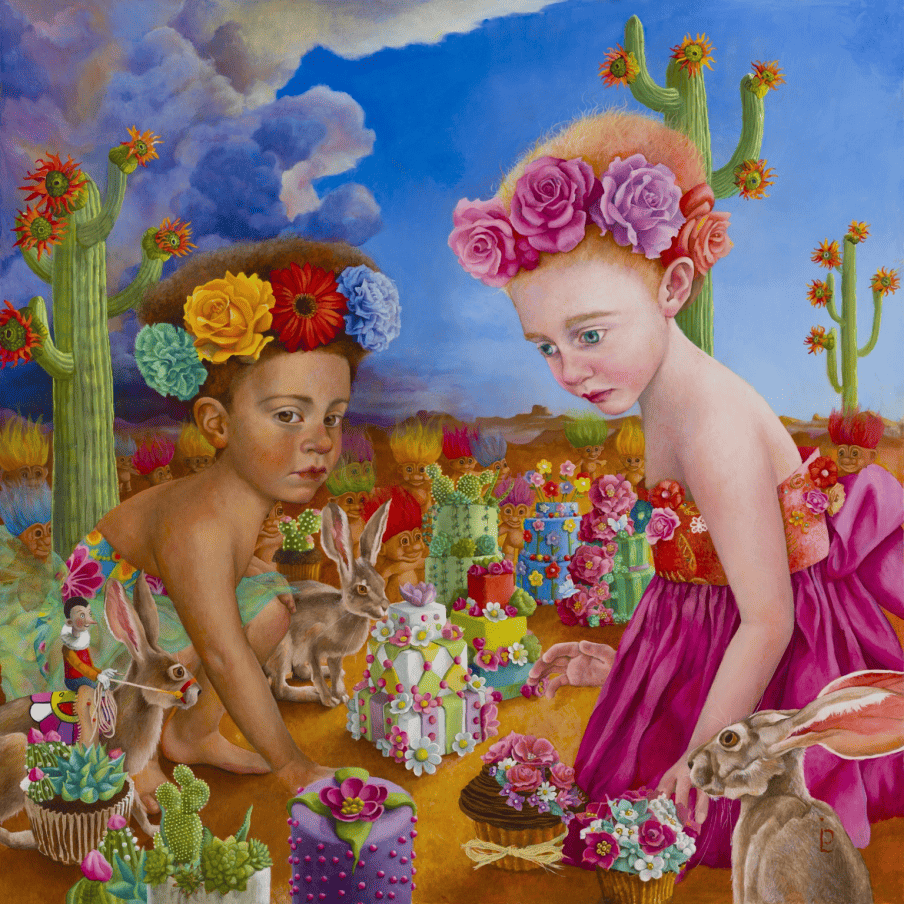
There’s something quietly moving about Esparza, Nadine and the Beautiful Wall, a response to the wall built between Mexico and the United States. Mason found the real wall both troubling and absurd, a structure that disrupts the natural movement of animals as much as people. Rather than dwell on that, she imagined something gentler: two young girls building their own wall out of cakes, meant to keep out trolls, not people. Pinocchio watches from nearby, a small reminder of how hard it’s become to separate truth from noise. There’s an innocence in the image that doesn’t erase the seriousness of its subject; it reframes it, asking what protection might look like if it came from care instead of fear.
The Question Flight Leaves Behind
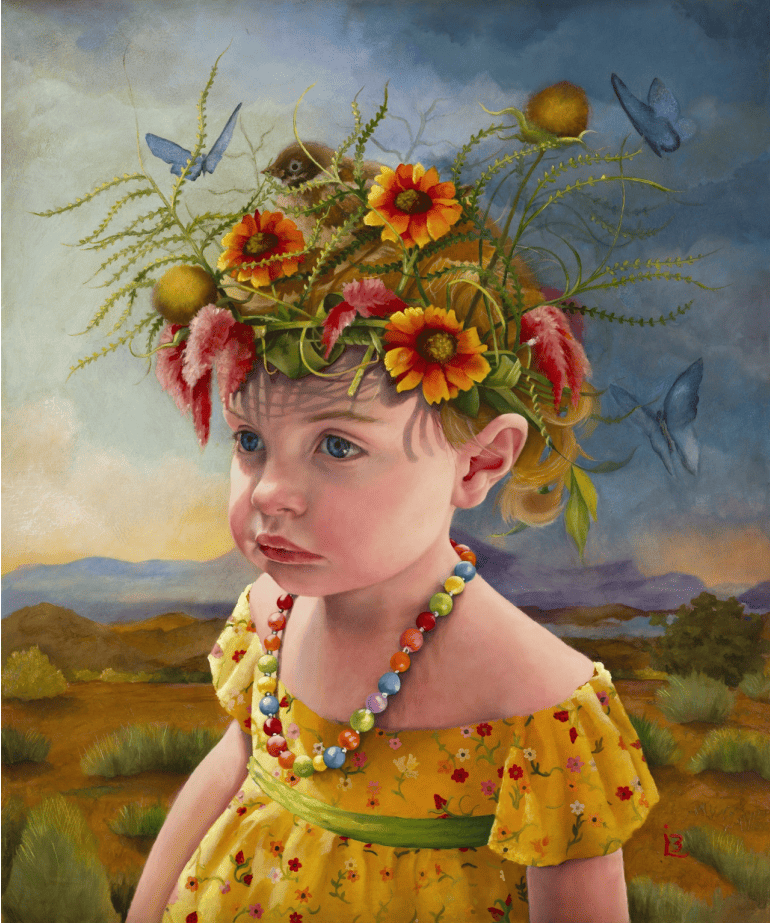
Flight is the quietest of the three, and maybe the hardest to look away from. A young girl stands alone in a barren landscape, and the painting doesn’t offer easy answers about how she got there or what comes next. It simply asks: what kind of planet are we leaving to our children? That question doesn’t resolve by the time you step away from the canvas. It’s not meant to.
Staying With It
What Mason seems to understand, across all three of these paintings, is that beauty doesn’t have to soften a hard subject, it can be the thing that keeps you looking at it long enough to actually feel its weight. Her paintings don’t ask for outrage or easy sympathy. They ask for attention, held a little longer than usual, on things that are genuinely difficult to hold. That, more than any single image, might be the most consistent thing about Lib Mason’s work: a willingness to sit with discomfort, and an invitation for the rest of us to do the same.
Take time to explore more of Lib Mason’s portfolio at libmasonartist.com. To follow along as she sits with new questions on canvas, connect with her on Instagram @libmason5687.