
Ask Michael Kaphengst where his creativity comes from, and he won’t start with a gallery or a teacher. He will tell you about Lego bricks and a piano. The answer says a lot about an artist who calls himself “The Linearist” and who insists he can’t paint beautiful pictures, “only interesting ones.”
A Childhood of Bricks and Music
After he came home from the children’s home, the young Kaphengst found his own way through the day by building. Lego bricks became cars, ships and houses, and he could happily spend hours at it. The work engaged his hands and his mind at once, and he found it deeply enjoyable.
The soundtrack to those hours was his mother’s playing. She suffered from severe manic depression, and she was also fiercely musical. At the piano she played Mozart, Beethoven, Bach and Vivaldi without sheet music, and she accompanied the local church choir on the organ when its members rehearsed at the house. Music, Kaphengst remembers, was her escape from everyday reality. He moved through the house with his Lego creations while she played, struck by the passion she brought to the instrument.
No Academy, No Apology
Kaphengst is candid that he never trained formally, and he is not apologetic about it. He doesn’t describe himself as a natural talent. He credits his motivation, his inner impulse and his joy in making things. He suspects that art school would have meant endless arguments with professors.
He is careful not to rank the two routes. But he is proud of the one he took. “Only life itself,” he says, can bestow true authenticity, and he regards the result as something purely his own, something that is quintessentially “Kaphengst.” In his view, that is worth more than any degree.
The Line Comes First
At the centre of his work is a simple reversal. “I see the line as the primary force,” he explains, “with the image emerging almost as a consequence.” He calls this approach linearism, and it grows out of a conviction that everyone lives inside linear processes. Our jobs, our habits and our free time are all sequences that we move through in our own way, and he is fascinated by how they shape our experience.
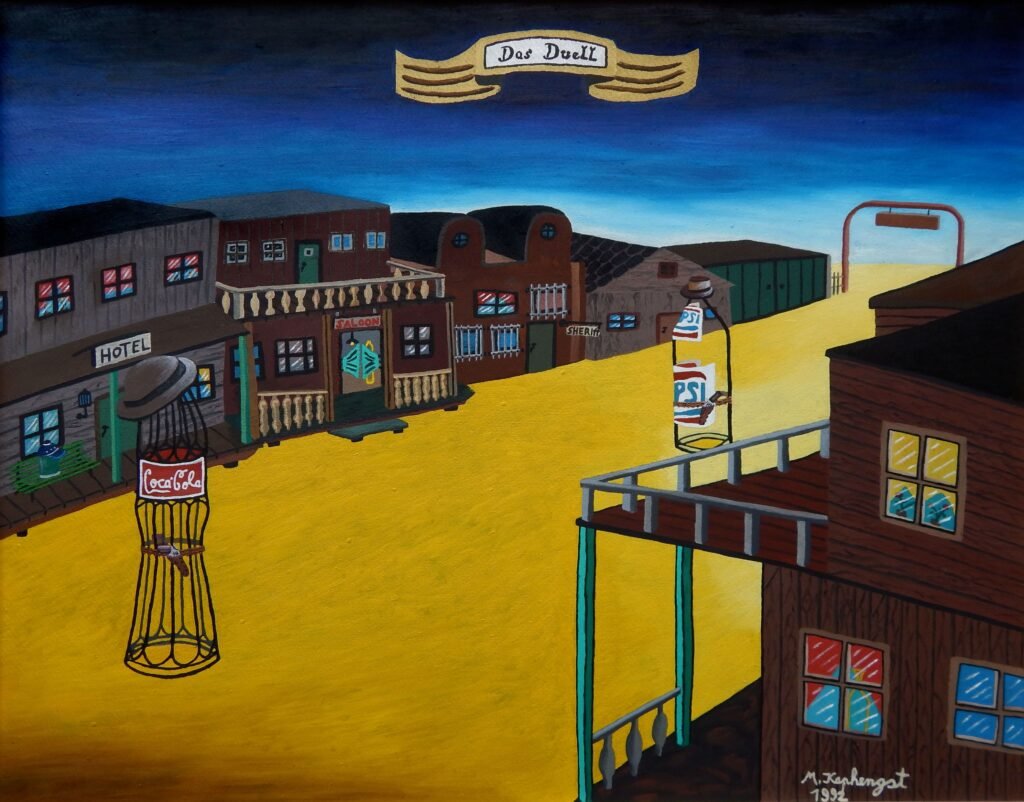
That includes the world of things we buy and use. Kaphengst doesn’t think of consumer culture as “pop.” He sees it as one more linear process we cannot escape. Treating it that way gives him fresh ground for new ideas, because everyday routines turn out to be full of material.
Three Ways of Drawing
Linearism takes three forms in his studio.
- Consumptive surrealism: Everyday consumer goods are set against a flood of linear sensation. They take on a new artistic meaning, and surreal images emerge from the objects that quietly shape our lives.
- Fencing paintings, or “absolute linearism”: In 2009 he began attaching a brush to the tip of a rapier and drawing with it, a technique he developed himself.
- Extreme linearism: Around 2012 he began experimenting with uncontrolled circular lines on paper. The pen’s loose circling gradually condenses a motif into one image with a moving energy. He calls it the most “extreme” form of his linearism.
What Tiles and Cocktails Taught Him
Kaphengst explains the gap between his absolute and extreme modes through two former jobs. As a tile setter, he worked calmly and with intense concentration, and the job demanded absolute focus. As a bartender, he had to work fast and with little time to think, and the pace was extremely demanding.
You can feel both in the work. One mode is slow and exact, and the other is quick and instinctive. He has turned the physical rhythms of ordinary working life into a method for making art.
A Nod from Rome
Although he stayed outside the academy, an academy has recognized him. The International Academy for Meaning in Poetry and Contemporary Art in Rome gave him a certificate that includes a critique of his work DOWN. The critique calls linearism a deconstruction and reconstruction of the norms of consciousness. It says the work breaks through the blindness of habitual seeing, the habits that fix our perspective and even breed prejudice. It describes a “Copernican shift” that turns sunrise into twilight and a paradox that unsettles the viewer’s ethics, leaving room for a new way of understanding.
Where It Began
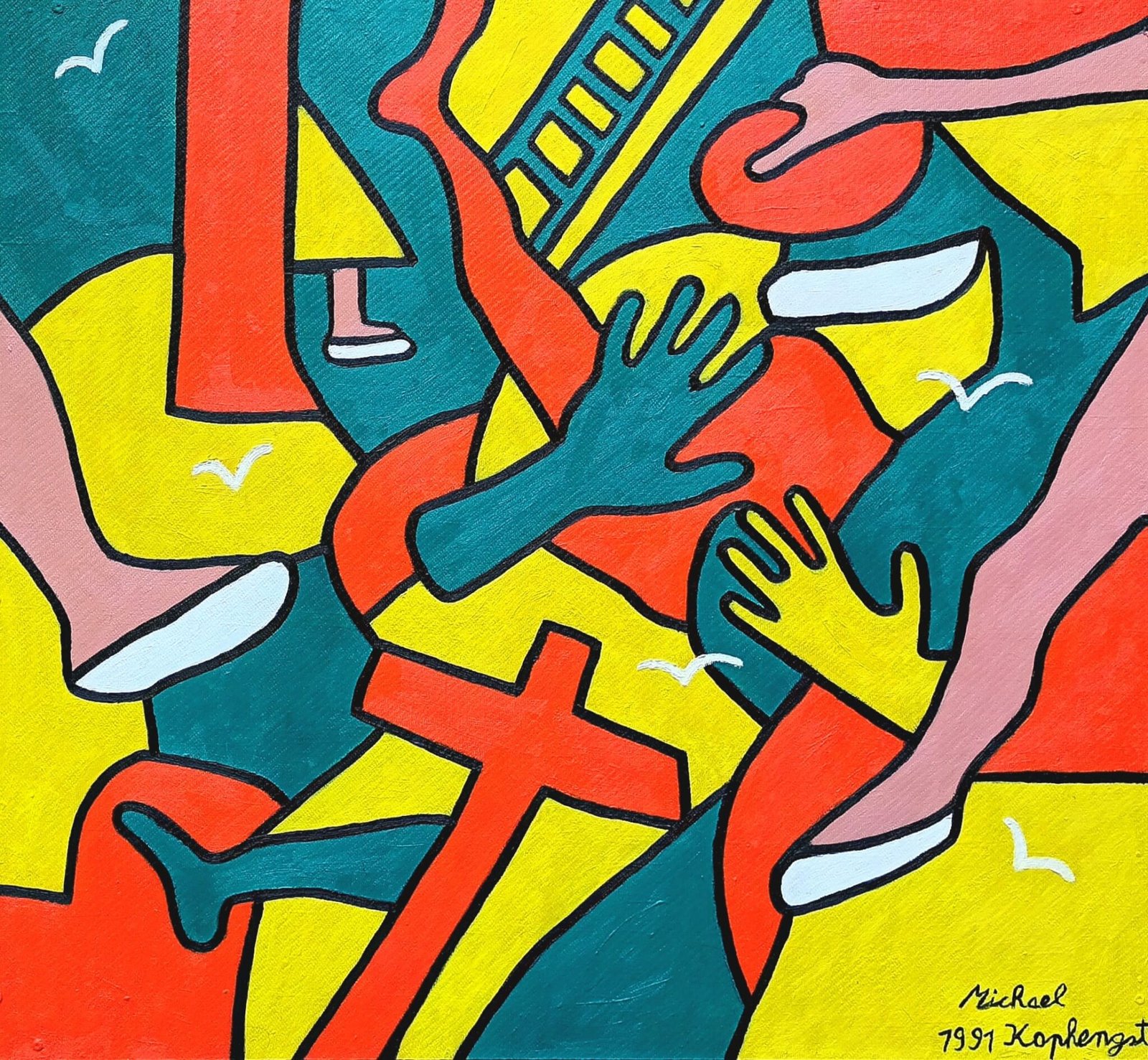
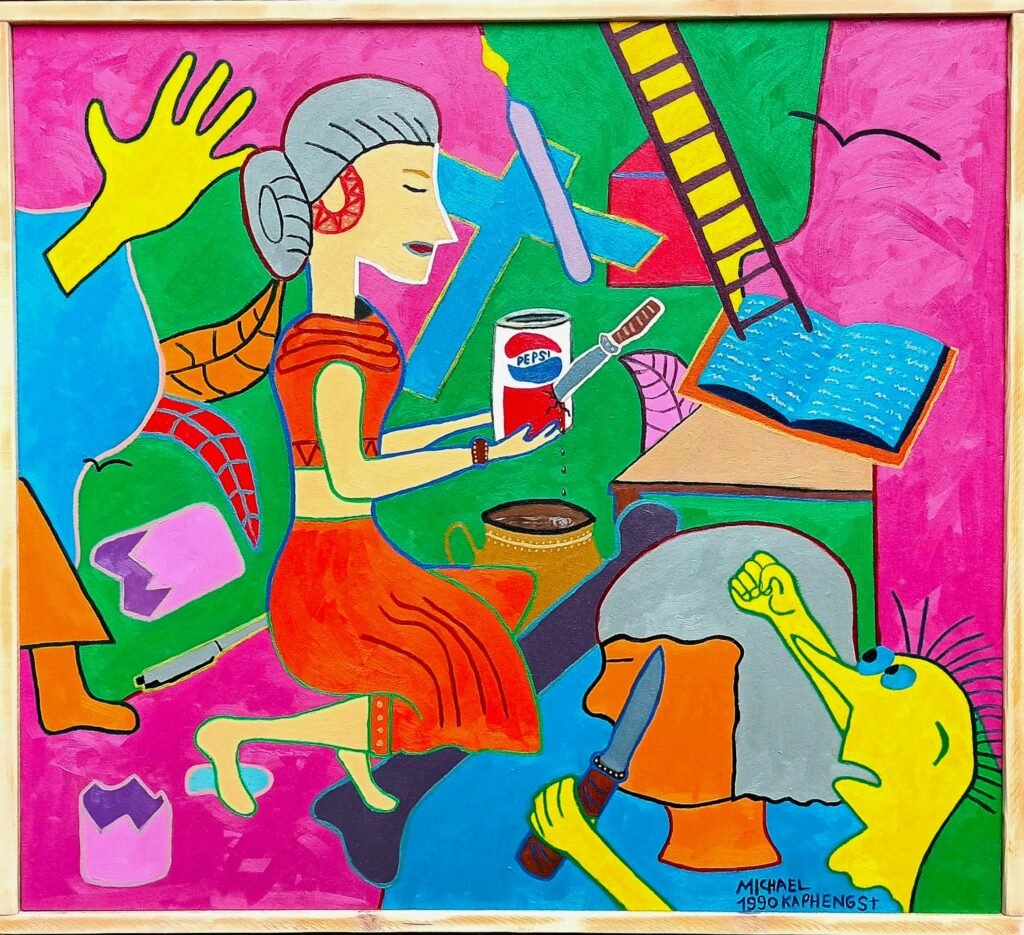
His earlier work includes Assassination (1990), Dancer (1991) and Duel (1992). The titles hint at the physical, confrontational energy that later became central to his fencing paintings.
The Last Word
Kaphengst’s remark about interesting pictures is not false modesty. It is a statement of purpose. He is not after pleasing surfaces. He wants work that holds our attention and makes us look again at the processes that shape our days.
Go behind the scenes of Michael Kaphengst’s studio, explore new pieces, and watch his line techniques come to life on Instagram: